Introduction
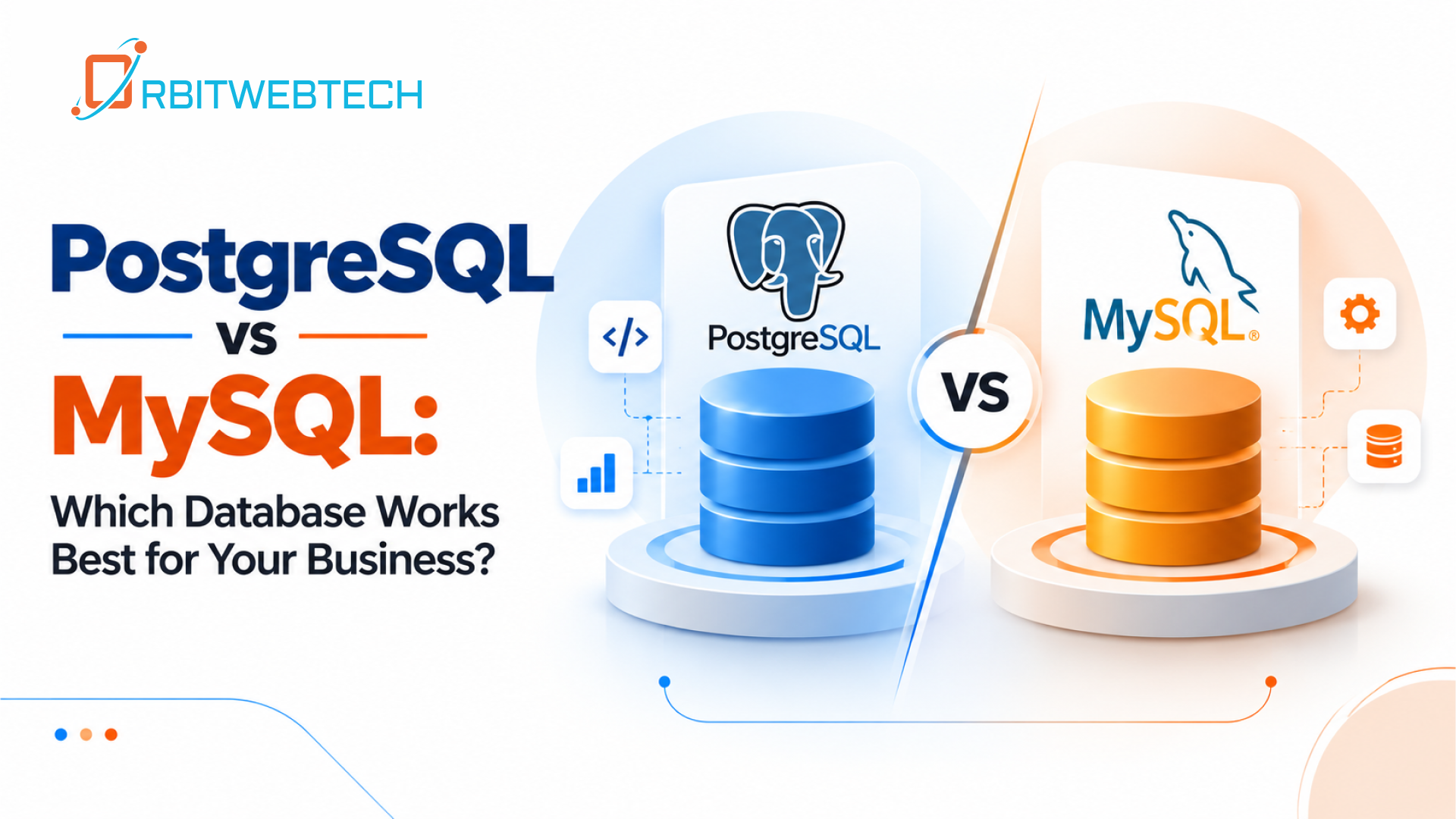
Choosing the right database can have a direct impact on how well your business applications perform, scale, and manage data. Two of the most widely used relational database systems are PostgreSQL and MySQL. Both are reliable, widely supported, and suitable for many types of applications, but they differ in features, flexibility, performance, and ideal use cases.
So, when comparing PostgreSQL vs MySQL, which database should your business choose?
The answer depends on your application requirements, data structure, development needs, expected growth, and the type of queries your system will handle.
This guide compares PostgreSQL and MySQL to help you understand their key differences and make a practical database decision.
What Is PostgreSQL?
PostgreSQL is an open-source relational database management system known for its advanced SQL capabilities, data integrity, and flexibility.
It supports complex queries, transactions, custom data types, JSON data, and advanced indexing. PostgreSQL is often used for applications that require detailed data relationships and sophisticated database operations.
Businesses may consider PostgreSQL when their applications need:
- Complex database queries
- Strong data integrity
- Advanced SQL functionality
- Complex relationships between data
- Custom data types
- Support for structured and semi-structured data
- Applications expected to grow over time
What Is MySQL?
MySQL is an open-source relational database management system that is widely used for websites, web applications, e-commerce platforms, and business software.
It is known for its straightforward setup, broad hosting support, and strong performance for many common application workloads.
A MySQL database can be a practical choice for businesses that need:
- A familiar relational database
- Reliable performance for web applications
- Simple database administration
- Broad hosting and development support
- E-commerce and content-driven websites
- Applications with primarily straightforward queries
PostgreSQL vs MySQL: Key Differences
Although both databases use SQL and support relational data, their approaches differ in several areas.
| Factor | PostgreSQL | MySQL |
|---|---|---|
| Database type | Object-relational database | Relational database |
| SQL capabilities | Extensive and advanced | Strong for common application workloads |
| Complex queries | Strong support | Good support |
| Data integrity | Strong focus on standards and constraints | Strong support with appropriate configuration |
| JSON support | Advanced JSON/JSONB capabilities | JSON support |
| Custom data types | Extensive support | More limited |
| Extensibility | Highly extensible | Less extensible |
| Common use cases | Complex applications, analytics, GIS, enterprise systems | Websites, ecommerce, web applications |
| Learning curve | Can be higher for advanced features | Often straightforward for common use cases |
The table provides a general comparison. Actual performance depends on database design, queries, indexing, hardware, configuration, and application architecture.
PostgreSQL vs MySQL for Performance
Database performance is not determined by the database engine alone. Query design, indexes, server resources, data volume, and application architecture all influence results.
MySQL can perform very well for applications that primarily use straightforward queries and predictable workloads. It is widely used for websites and applications where fast read operations are important.
PostgreSQL can be particularly useful when an application performs complex queries, requires advanced joins, uses sophisticated indexing, or handles different types of structured and semi-structured data.
Instead of choosing a database based only on general performance claims, businesses should test their expected workload.
What Affects Database Performance?
Several factors can influence performance:
- Query complexity
- Database size
- Index design
- Number of concurrent users
- Server resources
- Data relationships
- Application architecture
- Database configuration
- Frequency of read and write operations
A well-designed MySQL database can outperform a poorly designed PostgreSQL database, and the reverse can also be true.
PostgreSQL vs MySQL for Scalability
As a business grows, its database may need to handle more users, transactions, records, and application requests.
PostgreSQL provides a broad set of features for complex and growing applications. Its support for advanced queries, indexing, transactions, and extensibility makes it suitable for systems with evolving data requirements.
MySQL can also scale effectively and is used by many applications with large databases and significant traffic. Its suitability depends on how the application is designed and how the database workload changes as the business grows.
For both databases, scalability should be considered as part of the complete application architecture rather than as a database-only decision.
PostgreSQL vs MySQL for Data Integrity
Data accuracy is important for applications that manage customer records, financial information, orders, inventory, or other business-critical data.
PostgreSQL places strong emphasis on SQL standards, constraints, transactions, and data consistency. It provides extensive tools for defining relationships and enforcing rules within the database.
MySQL also supports transactions, foreign keys, constraints, and other mechanisms for maintaining data integrity, particularly when using the InnoDB storage engine.
The right configuration and database design are essential regardless of which system you choose.
PostgreSQL vs MySQL for Complex Queries
If your application relies on complex queries involving multiple tables, advanced filtering, aggregation, or sophisticated database operations, PostgreSQL is often considered because of its extensive SQL functionality.
MySQL handles many common queries efficiently and remains a popular choice for web applications and business websites.
For example, a basic e-commerce website may have relatively predictable queries involving:
- Products
- Customers
- Orders
- Payments
- Inventory
A large business application may require more complicated relationships, reporting queries, custom data types, and advanced data processing. In such situations, PostgreSQL may offer features that better match the application’s requirements.
PostgreSQL vs MySQL for Web Applications
Both PostgreSQL and MySQL can be used to build modern web applications.
MySQL has a long history of use with websites, content management systems, e-commerce platforms, and PHP-based applications.
PostgreSQL is also widely used in modern web development and works with popular programming languages and frameworks.
When selecting a database for a web application, consider:
- Application framework
- Developer experience
- Existing infrastructure
- Hosting environment
- Data complexity
- Expected traffic
- Reporting requirements
- Long-term maintenance
The database should support the application’s actual requirements rather than being selected simply because it is popular.
PostgreSQL vs MySQL for Security
Database security involves more than choosing a particular database system.
Both PostgreSQL and MySQL provide security features such as authentication, access controls, permissions, encryption options, and configuration controls.
Businesses should also implement:
- Strong authentication
- Role-based access
- Secure credentials
- Regular updates
- Database backups
- Network restrictions
- Monitoring and logging
- Secure application connections
- Least-privilege access
A properly configured database and secure application architecture are essential for protecting business information.
PostgreSQL vs MySQL: Which One Is Easier to Use?
For basic database requirements, MySQL is often familiar to developers because of its widespread use in web development.
PostgreSQL offers a large feature set, but some advanced capabilities can require a deeper understanding of database concepts.
The learning curve also depends on your development team.
If your developers already have extensive experience with one database system, that experience can be an important factor when making the decision.
When Should You Choose PostgreSQL?
PostgreSQL may be suitable when your business application requires:
- Complex Data Relationships
Applications with many interconnected tables and detailed relationships can benefit from PostgreSQL’s extensive relational features.
- Advanced SQL
If your application relies heavily on complex queries, aggregations, joins, or advanced SQL functionality, PostgreSQL can provide useful capabilities.
- Flexible Data Structures
PostgreSQL supports features such as JSON/JSONB and custom data types, making it useful for applications that work with different forms of data.
- Long-Term Application Growth
Businesses developing complex applications may choose PostgreSQL when they expect their database requirements to become more sophisticated over time.
When Should You Choose MySQL?
MySQL can be a practical option when your business needs:
- A Web-Focused Database
MySQL has extensive adoption across websites and web applications.
- Straightforward Data Requirements
Applications with conventional relational structures and predictable queries can work well with MySQL.
- Familiar Development Tools
If your development team already works extensively with MySQL, staying with a familiar database can simplify development and maintenance.
- Ecommerce or Content-Driven Applications
MySQL is commonly used for websites, ecommerce applications, and systems that manage products, customers, orders, and content.
- PostgreSQL vs MySQL: What Should Your Business Consider?
There is no single database that is appropriate for every business.
Before choosing between PostgreSQL and MySQL, evaluate these questions:
- What type of data does your application manage?
- How complex are your database queries?
- How many users will access the system?
- How much data do you expect to store?
- Does your application require advanced SQL features?
- What programming language and framework are you using?
- What database does your development team already know?
- What hosting environment will you use?
- What are your backup and security requirements?
- How might your database requirements change as the business grows?
Answering these questions gives you a better basis for selecting a SQL database than simply comparing general performance claims.
PostgreSQL vs MySQL: A Practical Decision
For businesses building straightforward websites, ecommerce platforms, or conventional web applications, MySQL can provide the relational database functionality needed for many common workloads.
For applications that require complex queries, advanced data structures, sophisticated relationships, or extensive database customization, PostgreSQL may be a better technical fit.
The important point is that PostgreSQL vs MySQL is not simply a question of which database is better. The right choice depends on your application’s workload, development team, infrastructure, data requirements, and long-term plans.
Need Help Choosing a Database?
Selecting a database is only one part of building a reliable application. Database architecture, schema design, indexing, queries, security, backups, and application integration all affect how well your system performs.
If you are planning a new web application, migrating an existing system, or reviewing your current database architecture, OrbitWebTech can help you evaluate your technical requirements and identify a database approach that fits your project.
Whether you are considering PostgreSQL, MySQL, or another database management system, start with your application’s actual requirements and build the database around them.